:grayscale(false):quality(10):blur(20):format(webp) "Academy Highlight")
:grayscale(false):quality(10):blur(20):format(webp) "MariaBehrens_SkyStyle26_Unit26_Guadeloupe_Duotone_by-TobyBromwich-7687")
Tom Auber x Cabo Verde
Uma sessão de alto desempenho em ondas de classe mundial.
Movido pelas ondas e alimentado pela paixão - antes e depois da Copa do Mundo de Ondas da GWA, Tom Auber passou algum tempo em Cabo Verde para perseguir linhas perfeitas e explorar todo o potencial de ondas da ilha. De sessões ao pôr do sol a offshores poderosos, essa viagem teve como objetivo reconectar-se com um local de ondas bastante desafiador.
:grayscale(false):quality(10):blur(20):format(webp) "MariaBehrens_byJohnCarter")
:grayscale(false):quality(10):blur(20):format(webp) "MARIAStill007")
:grayscale(false):quality(10):blur(20):format(webp) "MARIAStill010")
»Cabo Verde é um lugar que está em meu coração - ondas perfeitas, sessões diárias com o Float e passeios inesquecíveis ao pôr do sol tornaram essa viagem realmente especial.«
:grayscale(false):quality(10):blur(20):format(webp) "MARIAStill003")
Seu vídeo de Cabo Verde é muito inspirador. O que tornou essa viagem tão especial para você?
Cabo Verde ocupa um lugar especial em meu coração. Meus pais levaram meu irmão e eu para lá há alguns anos - foi uma de nossas melhores viagens em família. Desde então, tentamos passar o máximo de tempo possível lá todo inverno. É um lugar realmente mágico com condições incríveis.
Você estava usando a The Float nessa edição - o que faz dela a sua asa preferida para sessões de ondas?
Tive a sorte de receber duas asas Float pouco antes da viagem: uma 3.5 e uma 4.0. Elas têm uma faixa de vento tão ampla que eu pude surfar todos os dias durante três semanas - de 10 a 30 nós. A estabilidade da asa durante o voo livre a tornou perfeita para maximizar cada sessão de ondas em Cabo Verde.
Qual placa e configuração de lâmina você usou?
Com 67 kg, minha prancha preferida é a Sky Style 4'5" com 45 litros de volume. Para o foil, usei o mastro Slim D/LAB de 84 cm e alternei entre o Carve D/LAB 3.0 650 e 500, dependendo do tamanho da onda. Para melhorar o desempenho, combinei-os com a fuselagem D/LAB 37 e o estabilizador S165
Reading the Ocean
What are the top cues you personally look for when assessing wave conditions for Wing Foiling?
First, I always check the wind direction. The safest conditions for wave Wing Foiling are side-shore or side-onshore winds.
I also pay attention to wave size and the time between waves and sets. It’s important to observe where the waves consistently break to know where to paddle out and where to safely exit.
Always be aware of shore break, rocks, currents, or potential wind lulls at the spot. And if you’re unsure — ask the locals.
Mindset in Waves
Wave environments can be unpredictable. How does your mindset shift when preparing for a session in breaking waves compared to flatwater or freestyle conditions?
Wave riding is much more dynamic than flatwater sessions, and it takes time to feel fully comfortable with the conditions.
To be honest, I’m more nervous when I go Wing Foiling in waves. The ocean has more power than I do, and I know I might crash or get washed a few times. That means I need to ride efficiently and stay focused to save energy.
I constantly keep a 360-degree awareness of my surroundings — checking the horizon, watching the inside break, reading the sets, and positioning myself correctly.
Preparing mentally for different scenarios — like crashing, getting caught by a set, or losing gear — helps me stay calm and reduces stress in the water.
:grayscale(false):quality(10):blur(20):format(webp) "MariaBehrens_byTobyBromwich")
:grayscale(false):quality(10):blur(20):format(webp) "/Users/ben/Desktop/ActionPictures/42260-3519_MariaBehrens_Unit26_Product_Detail_LS_Guadeloupe_Duotone_by-TobyBromwich-0432.jpg")
Gear Choices for Waves
Wave Wing Foiling gear differs from freeride setups. What board and foil characteristics do you look for when heading into surf — and why are those choices important for performance and safety?
When heading into breaking waves, I prioritize control, glide, and agility.
For wave riding, I recommend a slightly smaller board — just enough volume to float comfortably. A smaller board reduces swing weight, makes turns easier to control, and feels lighter when flying, carving, or getting washed by whitewater. I personally ride the Sky Style SLS in 45L, which is almost 15 liters below my body weight.
The foil is the most important component because once you flag the wing, the foil becomes your engine. I prefer something between a high-aspect and low-aspect foil to combine good glide with agility. Waves generate a lot of speed and lift, so choosing a foil that’s too large can reduce control. For wave riding, I use the 650 Carve 3.0 and the 675 Crest.
In bumpy and wave-rich conditions, an 82 cm mast works best, as it helps manage steep sections and uneven water. Since waves already generate lift, I avoid positioning the mast too far forward. Placing it more toward the middle of the mast track provides better balance between control and agility.
Common Mistakes
Based on your experience, what are the most common mistakes riders make when taking their Wing Foiling into the surf — and how can they avoid them?
It already starts on the beach with choosing the wrong wing size. Many riders tend to go slightly too big. In wave riding, you want as little wing resistance as possible when carving. Choose the smallest wing that still allows you to get up on foil — but don’t oversize.
Another common mistake is riding too high on the foil. Especially in bumpy, wave-rich conditions with a lot of moving whitewater, staying too elevated reduces control and increases the risk of breaching.
For me, the biggest mistake in waves is a lack of attention and respect. Constantly scan your surroundings — watch for incoming sets, other riders, and the best wave sections. There is no other discipline where priority rules are as important as in wave riding. Not respecting them can quickly become dangerous, especially when foiling.
Progression Path
What progression path would you recommend for intermediate Wing Foilers who want to start catching unbroken waves and linking turns?
Start by matching the speed of the unbroken wave and focus on holding a clean line. Ride your foil slightly lower to avoid stalling and build confidence.
When beginning to turn, aim for a surf-style approach. Compress and extend with the wave’s shape. Keep your wing low and ideally in one hand to neutralize it as much as possible. Stay near the steeper part of the wave to feel the push — but not so high that you lose control.
As you improve, rely more on reading the wave’s energy rather than on wing power. Your riding will become smoother, more efficient, and more connected. Turns become more fluid and carvy, and the wing becomes less dominant.
That’s when Wing Foiling in waves truly starts to feel like surfing — with freedom.
:grayscale(false):quality(10):blur(20):format(webp) "MARIAStill002")
:grayscale(false):quality(10):blur(20):format(webp) "MARIAStill001")
Seu vídeo de Cabo Verde é muito inspirador. O que tornou essa viagem tão especial para você?
Cabo Verde ocupa um lugar especial em meu coração. Meus pais levaram meu irmão e eu para lá há alguns anos - foi uma de nossas melhores viagens em família. Desde então, tentamos passar o máximo de tempo possível lá todo inverno. É um lugar realmente mágico com condições incríveis.
Você estava usando a The Float nessa edição - o que faz dela a sua asa preferida para sessões de ondas?
Tive a sorte de receber duas asas Float pouco antes da viagem: uma 3.5 e uma 4.0. Elas têm uma faixa de vento tão ampla que eu pude surfar todos os dias durante três semanas - de 10 a 30 nós. A estabilidade da asa durante o voo livre a tornou perfeita para maximizar cada sessão de ondas em Cabo Verde.
Qual placa e configuração de lâmina você usou?
Com 67 kg, minha prancha preferida é a Sky Style 4'5" com 45 litros de volume. Para o foil, usei o mastro Slim D/LAB de 84 cm e alternei entre o Carve D/LAB 3.0 650 e 500, dependendo do tamanho da onda. Para melhorar o desempenho, combinei-os com a fuselagem D/LAB 37 e o estabilizador S165
Digital Coaching & Progression
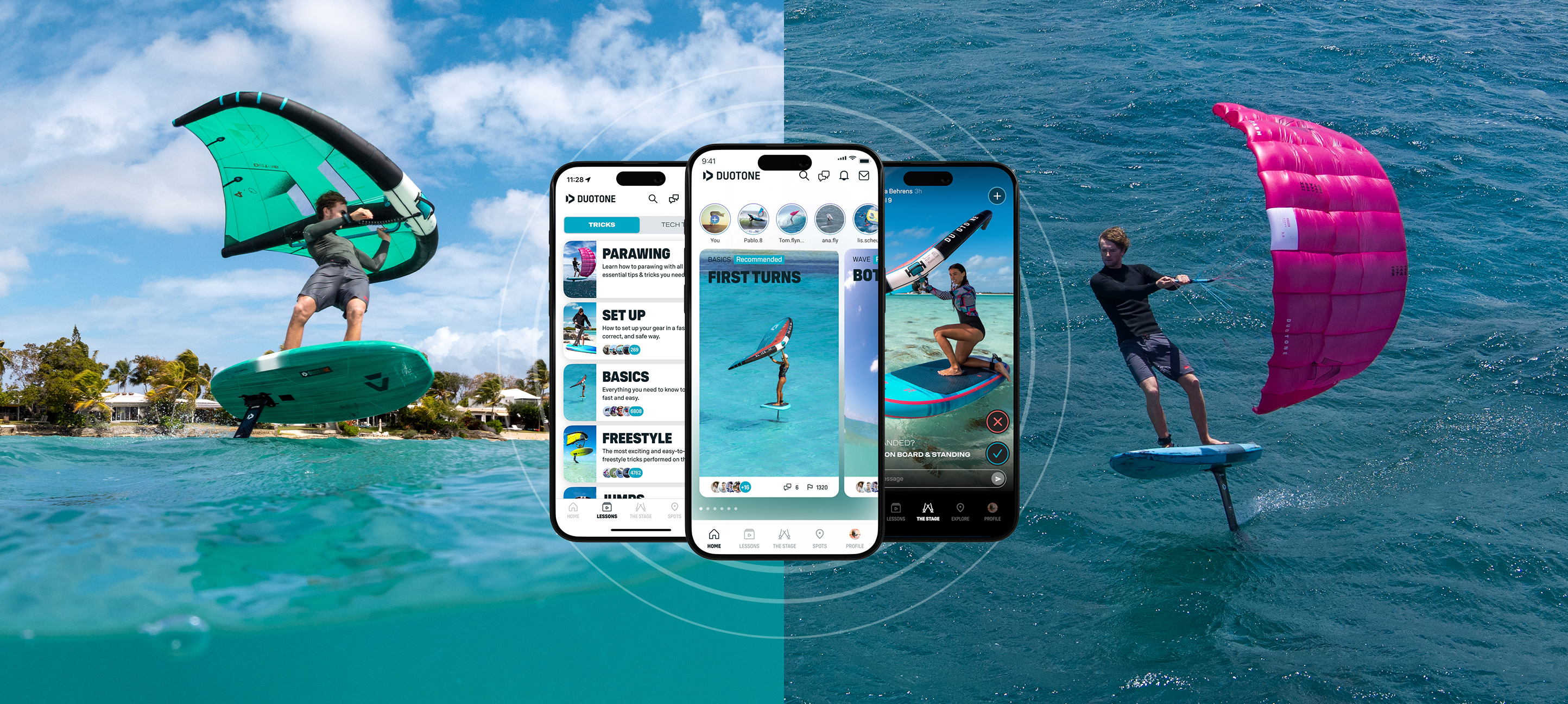
For riders transitioning into wave riding, how can tools like the Duotone Wing Academy App support progression?
The app organizes content into clear categories such as Set Up, Basics, Freestyle, Jumps, and Wave, allowing riders to follow their own progression path.
For many riders — including me — watching the video lessons in slow motion, with motion graphics and spoken explanations, makes it much easier to transfer the movements onto the water.
In my opinion, the most helpful modules for wave progression are Wave Selection, Frontside and Backside Riding, and Jibes and Tacks in Waves. These skills make a huge difference in both confidence and flow.
The built-in progression tracking and community interaction are great additional tools to receive feedback and stay motivated.
MAKE SURE TO HEAD OVER TO OUR ACADEMY APP FOR MORE!
:grayscale(false):quality(10):blur(20):format(webp) "MARIAStill010")