:grayscale(false):quality(10):blur(20):format(webp) "Academy Highlight")
:grayscale(false):quality(10):blur(20):format(webp) "MariaBehrens_SkyStyle26_Unit26_Guadeloupe_Duotone_by-TobyBromwich-7687")
Duotone Academy: How to Get into Wave Riding
Maria Behrens explains the fundamentals of Wing Foiling in waves — from positioning to timing and flow.
Taking your Wing Foiling into the waves opens up a whole new dimension of riding. But timing, positioning, and control become more important than ever. In this Duotone Academy feature, Maria Behrens breaks down the key basics to help you approach wave riding with confidence, flow, and the right technique from the very start.
Check out Maria’s tips in the video clip and interview below!
:grayscale(false):quality(10):blur(20):format(webp) "MariaBehrens_byJohnCarter")
:grayscale(false):quality(10):blur(20):format(webp) "MARIAStill007")
:grayscale(false):quality(10):blur(20):format(webp) "MARIAStill010")
»Wing Foiling in waves is so much fun. Take your time to understand the wave, and the confidence will come naturally.«
:grayscale(false):quality(10):blur(20):format(webp) "MARIAStill003")
Transitioning Skills
How do the basic skills from flatwater Wing Foiling translate when you start riding waves — and what should riders focus on first to progress confidently?
When learning in flatwater, you typically develop the ability to ride both directions and change stance. Being comfortable riding switch is a huge advantage in waves, as it allows you to adapt to any spot, regardless of wind direction.
Compared to flatwater, wave riding involves significantly more moving water. That makes strong foil control essential — especially pitch control, precise foot pressure, and efficient pumping technique.
Flatwater sessions also build solid wing control. In waves, this becomes even more important. The better you can neutralize the wing, the more fluid and surf-oriented your riding will feel.
To progress confidently, it’s crucial to understand how waves behave — where they break, how they reform, and where they lose energy — so you can position yourself correctly.
In the beginning, controlling the foil’s lift on a wave can be challenging. Foil control is key, and in some cases, choosing a slightly smaller foil can make handling easier and more manageable.
Reading the Ocean
What are the top cues you personally look for when assessing wave conditions for Wing Foiling?
First, I always check the wind direction. The safest conditions for wave Wing Foiling are side-shore or side-onshore winds.
I also pay attention to wave size and the time between waves and sets. It’s important to observe where the waves consistently break to know where to paddle out and where to safely exit.
Always be aware of shore break, rocks, currents, or potential wind lulls at the spot. And if you’re unsure — ask the locals.
Mindset in Waves
Wave environments can be unpredictable. How does your mindset shift when preparing for a session in breaking waves compared to flatwater or freestyle conditions?
Wave riding is much more dynamic than flatwater sessions, and it takes time to feel fully comfortable with the conditions.
To be honest, I’m more nervous when I go Wing Foiling in waves. The ocean has more power than I do, and I know I might crash or get washed a few times. That means I need to ride efficiently and stay focused to save energy.
I constantly keep a 360-degree awareness of my surroundings — checking the horizon, watching the inside break, reading the sets, and positioning myself correctly.
Preparing mentally for different scenarios — like crashing, getting caught by a set, or losing gear — helps me stay calm and reduces stress in the water.
:grayscale(false):quality(10):blur(20):format(webp) "MariaBehrens_byTobyBromwich")
:grayscale(false):quality(10):blur(20):format(webp) "/Users/ben/Desktop/ActionPictures/42260-3519_MariaBehrens_Unit26_Product_Detail_LS_Guadeloupe_Duotone_by-TobyBromwich-0432.jpg")
Gear Choices for Waves
Wave Wing Foiling gear differs from freeride setups. What board and foil characteristics do you look for when heading into surf — and why are those choices important for performance and safety?
When heading into breaking waves, I prioritize control, glide, and agility.
For wave riding, I recommend a slightly smaller board — just enough volume to float comfortably. A smaller board reduces swing weight, makes turns easier to control, and feels lighter when flying, carving, or getting washed by whitewater. I personally ride the Sky Style SLS in 45L, which is almost 15 liters below my body weight.
The foil is the most important component because once you flag the wing, the foil becomes your engine. I prefer something between a high-aspect and low-aspect foil to combine good glide with agility. Waves generate a lot of speed and lift, so choosing a foil that’s too large can reduce control. For wave riding, I use the 650 Carve 3.0 and the 675 Crest.
In bumpy and wave-rich conditions, an 82 cm mast works best, as it helps manage steep sections and uneven water. Since waves already generate lift, I avoid positioning the mast too far forward. Placing it more toward the middle of the mast track provides better balance between control and agility.
Common Mistakes
Based on your experience, what are the most common mistakes riders make when taking their Wing Foiling into the surf — and how can they avoid them?
It already starts on the beach with choosing the wrong wing size. Many riders tend to go slightly too big. In wave riding, you want as little wing resistance as possible when carving. Choose the smallest wing that still allows you to get up on foil — but don’t oversize.
Another common mistake is riding too high on the foil. Especially in bumpy, wave-rich conditions with a lot of moving whitewater, staying too elevated reduces control and increases the risk of breaching.
For me, the biggest mistake in waves is a lack of attention and respect. Constantly scan your surroundings — watch for incoming sets, other riders, and the best wave sections. There is no other discipline where priority rules are as important as in wave riding. Not respecting them can quickly become dangerous, especially when foiling.
Progression Path
What progression path would you recommend for intermediate Wing Foilers who want to start catching unbroken waves and linking turns?
Start by matching the speed of the unbroken wave and focus on holding a clean line. Ride your foil slightly lower to avoid stalling and build confidence.
When beginning to turn, aim for a surf-style approach. Compress and extend with the wave’s shape. Keep your wing low and ideally in one hand to neutralize it as much as possible. Stay near the steeper part of the wave to feel the push — but not so high that you lose control.
As you improve, rely more on reading the wave’s energy rather than on wing power. Your riding will become smoother, more efficient, and more connected. Turns become more fluid and carvy, and the wing becomes less dominant.
That’s when Wing Foiling in waves truly starts to feel like surfing — with freedom.
:grayscale(false):quality(10):blur(20):format(webp) "MARIAStill002")
:grayscale(false):quality(10):blur(20):format(webp) "MARIAStill001")
Safety Practices
Wave riding adds complexity with shorebreak, currents, and wind variation. What safety habits do you consider non-negotiable when Wing Foiling in a wave zone — from launch to exit?
The first thing I do when arriving at a spot is observe the conditions for at least 10 minutes. I check the set frequency, wave size, wind strength, and currents to fully understand the environment before going out.
After rigging, I always do a quick gear check to make sure everything is properly set up. I always warm up before any session — and I always wear a helmet when wave Wing Foiling.
Once on the water, I start calmly and take smaller waves first to get familiar with the conditions and my setup. As I gain confidence, I gradually move into bigger waves and more critical sections.
When exiting, I head back to the beach behind a set to avoid heavy shorebreak and reduce the risk of crashes. Timing your exit is just as important as timing your take-off.
Digital Coaching & Progression
For riders transitioning into wave riding, how can tools like the Duotone Wing Academy App support progression?
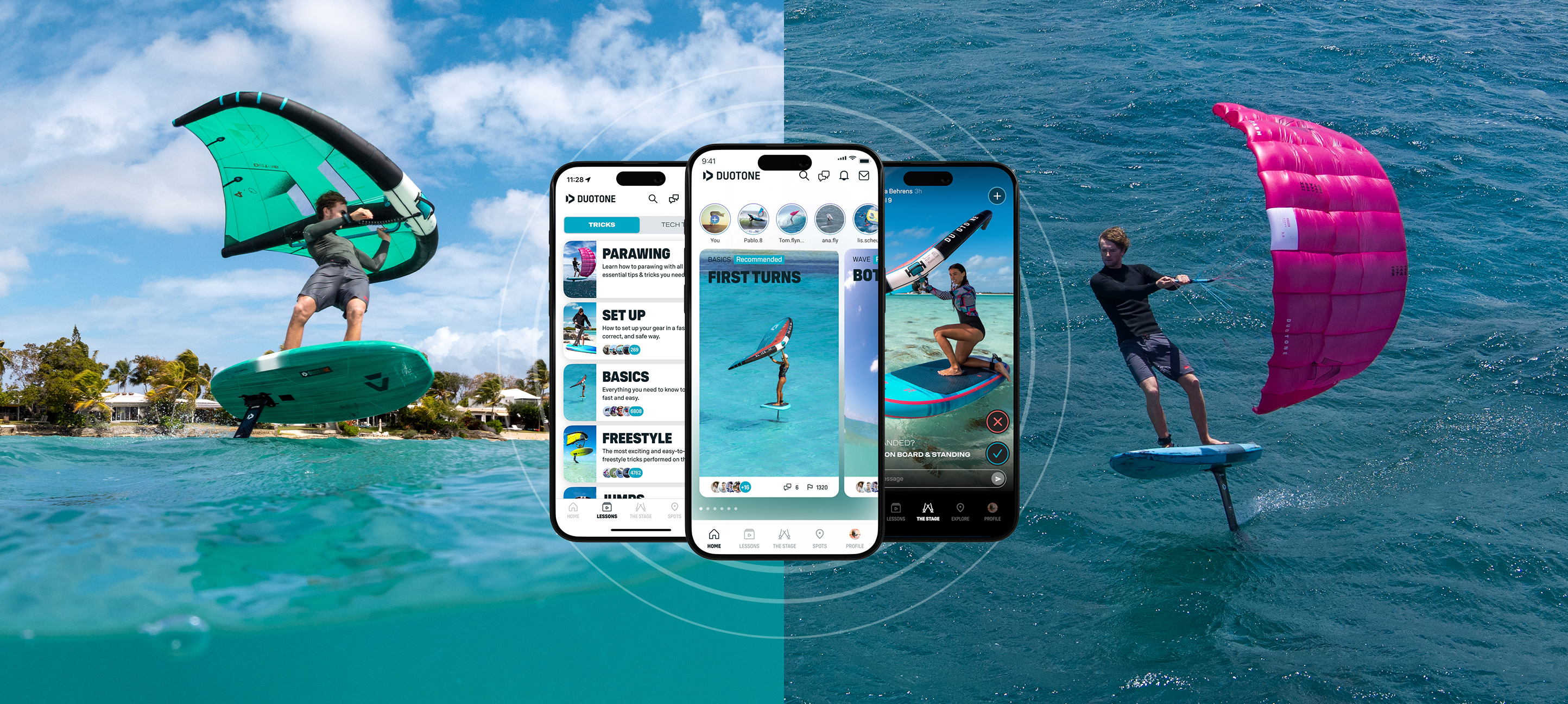
The app organizes content into clear categories such as Set Up, Basics, Freestyle, Jumps, and Wave, allowing riders to follow their own progression path.
For many riders — including me — watching the video lessons in slow motion, with motion graphics and spoken explanations, makes it much easier to transfer the movements onto the water.
In my opinion, the most helpful modules for wave progression are Wave Selection, Frontside and Backside Riding, and Jibes and Tacks in Waves. These skills make a huge difference in both confidence and flow.
The built-in progression tracking and community interaction are great additional tools to receive feedback and stay motivated.
MAKE SURE TO HEAD OVER TO OUR ACADEMY APP FOR MORE!
:grayscale(false):quality(10):blur(20):format(webp) "MARIAStill010")