Fin Race D/LAB (Tuttle)
FREERACE/SLALOM CARBON FIN
C91:black/carbon
WHY OFFERING 3 DIFFERENT TECHNOLOGIES?
Here are the differences:
Injection molded fins are manufactured using a metal outside mold. Our exclusive CARBO_TECH material —a proprietary blend of thermoplastic polymer and carbon fibers— is injected into the mold under extremely high pressure and heat.
Advantages:
- Since this material is softer than G10 it's the ideal choice for shorter maneuver side fins to ensure the necessary tip flex despite the short length.
Disadvantages:
- For fins longer than 12cm, injection molded fins are too soft to ensure a proper performance.
Best suited for:
Injection molded fins are the ideal choice for short side fins.
HERE IS HOW A CARBO_TECH FIN IS MANUFACTURED
3D File to generate the injection mold

Injection steel mold with injection pressure hoses
Finished fins right out of the mold
G10 is an extremely compressed block of prepreg laminated fiberglass sheets. This block is placed in a CNC milling machine to create the final shape and profile.
Advantages:
- Due to its high-compression G10 is extremely durable.
- Easy to sand, allowing to repair damages caused by ground contact.
Disadvantages:
- The high-compression results in a higher weight, which is noticeable with longer fins.
- Not stiff enough for longer high-performance freeride/race fins.
Best suited for:
G10 is the ideal choice for medium-size maneuver center fins.
HERE IS HOW A G10 FIN IS MANUFACTURED
Highly compressed G10 blocks

CNC milling the outline and profile

Cleaning milling residues

Finished fins with unfinished optic
This is the most sophisticated method of manufacturing a fin. It is based on individual pre-impregnated (prepreg) fiber layers out of carbon and glass. These layers consist of single fibers that are laid side by side onto a carrier film and then pre-impregnated with resin by a specialized supplier in an industrial hydraulic press. This ensures the ideal ratio between fibers and resin (not too much, to avoid excessive weight and ensure a perfect bond between the layers, and not too little, to avoid dry spots that can lead to breakage) even before it is further processed by our factory.
For these reasons, prepreg fins are at least 50% stronger in terms of breaking strength than the standard/conventional RTM technology, which uses dry fibers with "uncontrolled" resin addition.
Advantages:
- Flex and twist are not only determined by the length, width, and profile thickness of the fin design (as with G10 fins), but can also be adjusted by the arrangement of the prepreg layers.
- Lighter than G10.
Disadvantages:
- Not as easy to repair damages caused by ground contact.
- The most expensive way to manufacture a fin.
Best suited for:
Prepreg fins are ideal for longer high-performance fins from freeride up to racing.
HERE IS HOW A PREPREG FIN IS MANUFACTURED
3D file to generate the mold

Milling the fin shape into a metal block to create the mold

Finished mold halves

Storage of pre-impregnated fiber layers in a refrigerator to prevent the resin from hardening

Templates for cutting the prepreg fiber layers

Cutting the prepreg fiber layers

Putting the single fiber layers into each mold halve

Mold halve (with non-stick coating) filled with carbon and glass fiber layers

Vacuum molding of the fin

Finished fin

PRODUCT DETAILS
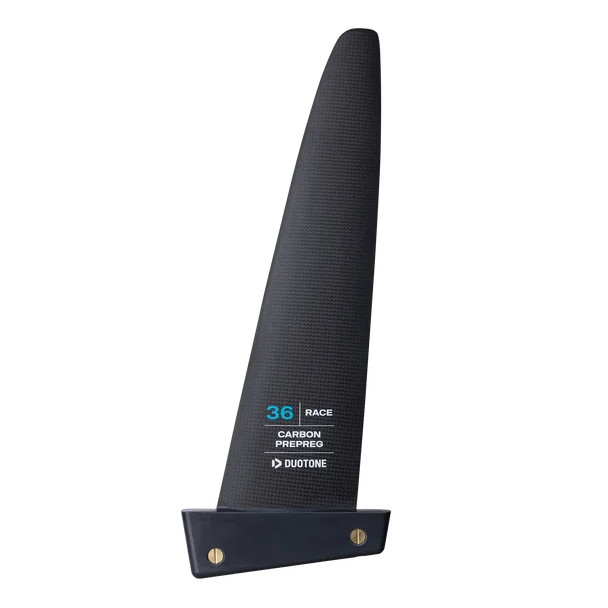
Just like every product bearing the D/LAB label, the RACE D/LAB fin represents the pinnacle of technology and performance. The high-end design is PWA approved yet it's not ultra technical to sail making it the ideal aftermarket upgrade for any Freerace up to World Cup Slalom board.
Designed as Duotone's signature slalom fin for ultimate performance in the most demanding conditions, the RACE D/LAB delivers the lift required to keep your board perfectly balanced even in maxed-out conditions — giving you the speed and control to lead the fleet at that crucial first mark. A balanced design was central to its development, making it equally capable when heading downwind, upwind, or through sharp turns.
The construction is based on our Molded Prepreg Technology — the most advanced and most expensive fin construction available. Individually oriented carbon layers guarantee the stiffest possible base combined with a perfectly tuned tip-flex. The RACE D/LAB features the highest carbon content and quality of all our fins resulting in the highest reflex speed for maximum performance. This is premium engineering you can feel the moment you're on the water.
That construction standard enabled designer Dani Aeberli to use the thinnest profile of our entire fin range, minimising drag for maximum performance and top-end v-max. A super-stiff base combined with a sophisticated flex pattern — carefully limited to the very tip of the fin — delivers exceptional control while keeping the fin from ever feeling nervous or overly technical to sail. The result is a fin that's genuinely accessible, even on Freerace boards.
Going beyond your imagination - the RACE D/LAB sets a new performance benchmark to satisfy both competitive racers and speed-hungry amateurs.
* Tuttle base specs: 50x31mm | Medium Tuttle base specs: 67x50mm
** Please see below under FIN SIZE RECOMMENDATIONS BY JORDY VONK
:grayscale(false):quality(10):blur(20))
TECH AND SHAPE FEATURES


+6 WARRANTY
REGISTER YOUR NEW DUOTONE FIN FOR FREE ON OUR WEBSITE WITHIN 60 DAYS OF PURCHASE AND RECEIVE AN UNRIVALED EXTENDED WARRANTY OF 6 MONTHS BEYOND THE LEGAL WARRANTY PERIOD OF YOUR COUNTRY (EXCLUDING DAMAGES THROUGH GROUND CONTACT).
PLEASE REGISTER HERE
Any comments or questions? Here you’ll find first hand R&D / rider Information.
The more info you provide, the more specific the advice/help will be. Please let us know:
Your skill level
Your body weight and size
Mast(s) you plan on using with the sail
Board(s) you are using
Conditions/spots you are sailing at
Please note: To help as many people as possible follow the thread, the forum language is English only.
:grayscale(false):quality(10):blur(20))


:grayscale(false):quality(10):blur(20))